Implants are the right answer once a tooth can’t be saved. Here is how I handle them at Johnstown Dental Care.
By Dr. Brian Walsh, DDS, Johnstown Dental Care
If you are searching for a dentist in Johnstown who offers dental implants, you are probably dealing with a tooth that is failing or already gone. That is a stressful place to be, and I want you to have a clear picture before you pick up the phone.
Here is the short answer. Yes, we place dental implants at Johnstown Dental Care. I place both two-piece implants and one-piece implants, commonly called mono implants, and I choose the one that fits your anatomy and your health. But I don’t start with an implant. I start with an exam, because whether an implant is the right choice depends on your gums, your bone, your bite and the reason the tooth is in trouble, and you can’t judge those things on your own.
My first goal is always to save your natural tooth. When that is no longer possible, an implant is a sound, well-established way to replace it.
Key Takeaways
- I place dental implants at Johnstown Dental Care, both two-piece and one-piece (mono) implants.
- Every implant recommendation starts with an exam, so I can check your gums, bone, bite and the cause of the problem first.
- If a tooth can be saved, I will try to save it. Implants come into the conversation when it can’t be.
- Published 10-year survival rates for implants run from about 93% to 96%, and the care you give them afterward matters.
- Gum disease, smoking, teeth grinding and diabetes all affect how an implant does, which is why I evaluate each patient individually.
Why Do I Start With An Exam Instead Of An Implant?
Because the exam tells me whether an implant is the right answer at all.
When you come in, I look at what you can’t see in a mirror:
Why the tooth is failing. Decay, a crack, gum disease and an old injury each call for different decisions. If the tooth can be repaired, that is where we begin.
Your gum health. Gum disease is a key contributor to problems around implants. A review of implant outcomes found that survival in patients with periodontitis has been about 90%, and that periodontitis is a risk factor for implant loss. If your gums need treatment, we take care of that first.
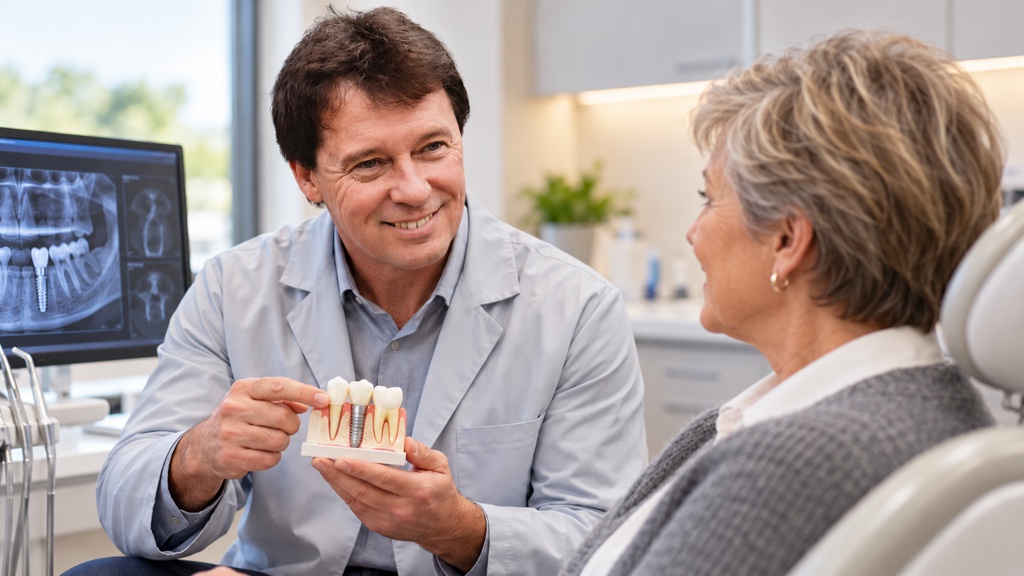
Your bone. An implant needs healthy bone to hold it. I use 3D imaging along with the exam to see what you have, and that helps me decide which type of implant suits you.
Your bite and habits. Teeth grinding (bruxism) and diabetes have both been linked to shorter implant survival, especially alongside other risk factors. Smoking is among the leading factors linked to implant failure, including a higher risk of implant loss and infection around the implant.
Your restorations and neighboring teeth. I check the teeth on either side and any crowns or fillings you already have, so the replacement fits into the whole picture.
Some autoimmune conditions can also make getting an implant more challenging. Each of these is a reason the decision belongs in an exam room, not a search result.
This is what Sensible Dentistry means to me: honest options, no pressure, and decisions based on what will serve your long-term health. You can read more about how I practice. I also welcome second opinions.
When Is An Implant The Right Answer?
The order I follow is simple: watch and prevent, repair, and replace only when necessary.
An implant becomes the right answer when there is genuinely no sound path to keeping the natural tooth. At that point, leaving a gap is not a neutral choice. An empty space lets neighboring teeth drift over time and can affect your bite.
An implant replaces the root as well as the visible tooth. The titanium post integrates with your jawbone. And unlike a traditional bridge, an implant doesn’t require reshaping the healthy teeth on either side.
What Is The Difference Between One-Piece And Two-Piece Implants?
I place both, and I choose based on what your anatomy calls for, not on convenience.
A two-piece implant has a post that sits in the bone and a separate piece that connects the post to the tooth.
A one-piece implant, commonly called a mono implant, goes directly into the bone, with the implant and the post that holds the tooth made as a single piece. Many times when a two-piece implant would call for a bone graft, a one-piece implant avoids the graft. Whether that applies to you is something I decide from your exam and 3D imaging.
I can’t tell you which type you will need before I see your mouth. That decision comes from the exam, and I will explain what I see and why I recommend it.
What Do The Numbers Say About How Well Implants Last?
Implants have a well-established track record. A 10-year meta-analysis reported implant survival of 93.2% to 96.4%, and another review estimated about 96.4% survival at 10 years for contemporary implant systems.
Two things are worth knowing about those numbers.
Failures tend to happen early. Research following implants for 20 to 30 years found that failures happen mostly in the first few years after placement, and that late failures do not rise steadily over time.
Maintenance matters. The most frequent complication is peri-implantitis, an inflammatory process triggered by bacterial plaque that affects the gum and bone around the implant. Reported rates vary widely depending on how it is diagnosed. A history of gum disease, poor plaque control and missed maintenance visits are key contributors, and one retrospective study linked missed maintenance appointments after implant therapy to a possible higher risk.
That is why I treat gum disease before I place an implant, and why the follow-up visits are part of the plan from the start. An implant, like a natural tooth, needs daily brushing and flossing and regular checkups. The crown and other parts may also need repair or replacement over the years.
What Can You Expect At Your Visit?
We don’t do a separate pre-visit consultation. I consult with you when you arrive, and depending on what I find, we may be able to start treatment that day. I’ll explain what I see, what your options are and what I recommend. If you want time to think or get a second opinion, that is fine.
If you are nervous about treatment, we offer oral and IV sedation. Ask about it when you call, and we will talk through what fits you.
How To Get Started
- Call our office at (740) 967-6046. We don’t take walk-ins, so calling first saves you a trip. If you are in pain, tell us, since we leave room in the schedule for urgent cases.
- Tell us what is going on. Which tooth, how long, and anything you have noticed, such as pain, swelling or a loose tooth.
- Come in for your exam. I’ll check the tooth, your gums, your bone and your bite, and tell you what I see.
- Decide together. If the tooth can be saved, we start there. If an implant is the right answer, I’ll explain the plan and which type of implant I recommend.
- Plan for the long term. Brush, floss and keep your maintenance visits. Learn about our payment plans if cost is a concern.
Frequently Asked Questions
Does Johnstown Dental Care place dental implants?
Yes. I place dental implants at Johnstown Dental Care in Johnstown, Ohio, both two-piece and one-piece (mono) implants. Every recommendation I make begins with an exam of your teeth, gums, bone and bite, and I try to save the natural tooth first whenever that is possible.
What is a one-piece (mono) implant?
A one-piece implant, commonly called a mono implant, goes directly into the bone, with the implant and the post that holds the tooth made as one piece. I place both one-piece and two-piece implants, and I choose between them after your exam and 3D imaging.
How long do dental implants last?
Published 10-year implant survival rates run from about 93% to 96%. Most failures happen in the first few years after placement. I ask my patients to brush and floss daily and keep their maintenance visits, and I tell them the crown or other parts may eventually need repair or replacement.
Who is not a good candidate for an implant?
I decide candidacy at the exam. Gum disease, smoking, teeth grinding, diabetes, some autoimmune conditions and too little bone can all raise risk. I address what can be addressed first, and I evaluate each patient individually before I recommend an implant.
Do I need gum treatment before an implant?
If you have gum disease, I treat and stabilize it before placing an implant and keep watching it afterward. A history of gum disease is a key contributor to problems around implants. Daily cleaning at home and regular maintenance visits with me help protect the gum and bone around the implant.
A Missing Tooth Deserves A Careful Answer
Losing a tooth is hard, and the right next step is rarely the fastest one. It is the one based on what is actually happening in your mouth.
That is the step I take with every patient. If you have a failing or missing tooth, call Johnstown Dental Care at (740) 967-6046 to schedule your exam.
The right implant decision starts with someone examining your mouth, not a search result.
Keep Learning
- Dental Implants at Johnstown Dental Care: the implant options I offer.
- Services at Johnstown Dental Care: everything we offer, from cleanings to implants.
- Family Dentistry: ongoing care that helps you keep your natural teeth.
- Our Philosophy: how Sensible Dentistry guides every recommendation.
- Payment Plans: ways to fit treatment into your budget.
About The Author
Dr. Brian Walsh, DDS, owns Johnstown Dental Care in Johnstown, Ohio, where he provides family, restorative and cosmetic dentistry, including two-piece and one-piece dental implants. He built the practice after buying it from a retiring dentist, and he practices what he calls Sensible Dentistry: honest options, no pressure, and treatment decisions based on what will serve each patient best over the long term.
Other locations served:
- New Albany OH
- Sunbury OH
- Granville OH