
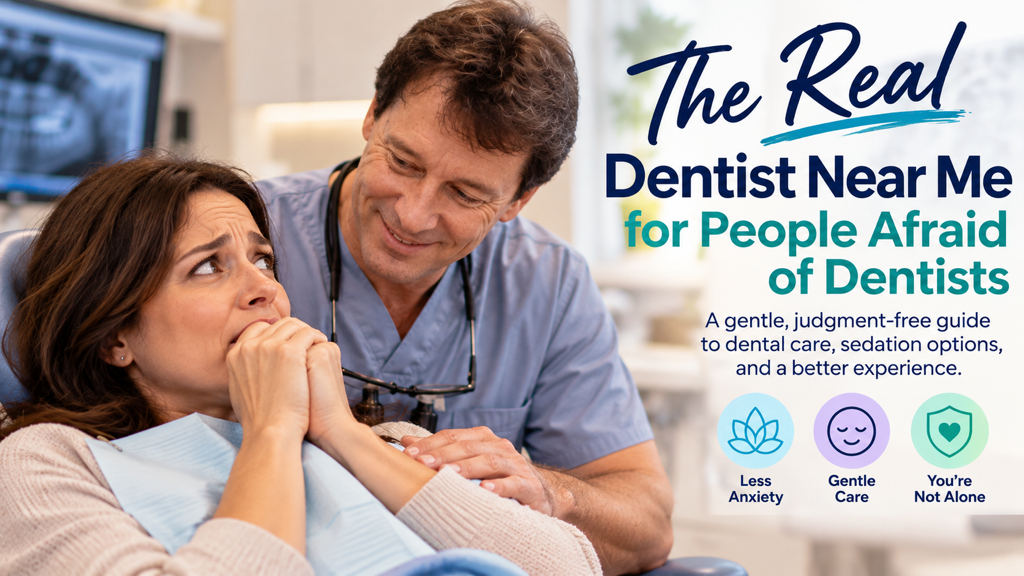
Afraid of the dentist? This guide helps you find a gentle, judgment-free dentist near me for dental anxiety, including sedation options that actually work.
You know you need to go. You’ve known for a while, maybe years. But every time you think about calling to schedule, something stops you, and it’s not laziness. It’s that specific dread that sits in your chest the moment you imagine the sounds, the smells, the feeling of having no control. If that’s you, you’re not alone, and you are definitely not being dramatic. Dental anxiety is one of the most common reasons people delay care until a small problem becomes a big, expensive one.
This guide was written for exactly that person. You’ll learn what to look for in a dentist who actually gets it, what questions to ask before you even sit in the chair, what sedation options exist and which ones are right for which level of fear, and why Johnstown, OH has a dentist, Dr. Brian Walsh at Johnstown Dental Care, whose whole approach is built around patients like you. By the time you finish reading, you’ll know how to find a gentle dentist near me, what to expect from your first visit, and how to take one small step that could change your relationship with your health for good.
This is what some of our patients had to say:
Tammy: “Dr. Walsh has always made me feel comfortable. I’ve had a lot of dental work in my lifetime so I’m very afraid of the dentist. The staff is always friendly and professional. Thank you for providing such excellent service.”
Kelley: “Really appreciate the care they give me since I have a fear of dentists. Best dentist office around for people like me.”
Why So Many People Are Looking for a Dentist Near Them for People Afraid of Dentists
By the end of this section, you’ll understand exactly why dental fear is so common, why it quietly compounds over time, and why finding the right provider (one built for people like you) is worth the effort.
Let’s start with this: you’re not unusual.
The Fear Is Everywhere, and It’s Real
Globally, about 15% of adults are affected by dental fear and anxiety, with a notable 12.4% suffering from high levels, and approximately 3.3% experiencing severe dental anxiety or dental phobia, according to a 2021 review of 31 studies covering more than 72,000 adults. If you prefer a wider lens, a 2025 national survey published in the Journal of the American Dental Association found that nearly 73% of U.S. adults report some level of dental fear. Those numbers aren’t a rounding error. That’s tens of millions of people quietly dreading the same thing you are.
The fear doesn’t come from nowhere. Various factors contribute to dental anxiety, including past traumatic experiences, fear of pain, needles, or loss of control during procedures. For many people, it traces back to one bad experience: a dentist who rushed, didn’t listen, or caused pain they weren’t warned about. About half of adults with dental anxiety trace it back to childhood, and a bad experience in the dental chair is the most consistent cause.
That history follows people. It shows up as a tight chest when you drive past a dental office. It shows up as weeks of rehearsing a phone call you never make.
What the Silence Actually Costs
Here’s the part that matters most, and I won’t soften it: avoidance has a price.
Dental anxiety creates a cycle that’s hard to break: anxiety leads to avoidance, avoidance allows problems to worsen, and worsening problems create more anxiety and shame about the state of your teeth. The research bears this out: people with high dental anxiety tend to have more untreated decay and more missing teeth. Avoidance is how most people cope with the fear, and avoidance is exactly what keeps the cycle turning.
The financial hit compounds just as fast. A small cavity that causes mild discomfort might cost $150 to $400 to fill during a routine visit. Skip that appointment, and the decay spreads deeper into the tooth, eventually requiring a root canal that runs $700 to $1,500, before insurance and usually before the crown that follows (national fee data). Put simply, putting off a $200 filling can turn it into a bill five times that size.
Waiting doesn’t make it safer. It makes it harder, and more expensive.
The Search That Brings People Here
So people start searching. They type things like dentist near me for people afraid of dentists, or how to find a gentle dentist near me, or best dentist for dental anxiety and phobia. They’re not looking for a standard cleaning appointment. They’re looking for someone who actually gets it: a provider who won’t make them feel judged, won’t rush them, and won’t minimize what they’re feeling.
That search is exactly what this guide is built to answer. The sections ahead walk you through what actually separates an anxiety-friendly practice from a standard one, how sedation dentistry works, and how to find a sedation dentist near me for nervous patients who fits your specific level of fear.
You deserve care that works for you. The rest of this guide shows you how to find it.
What Actually Makes a Dentist ‘Good for Anxious Patients’ (Most Practices Won’t Tell You This)
Here’s what this section covers: the real difference between a practice that markets itself as anxiety-friendly and one that actually is, and the specific questions you can ask before you book a single appointment to tell them apart.
Because that distinction matters more than most people realize.
The Marketing Phrase vs. the Real Thing
Almost every dental website now has some version of “we welcome anxious patients.” It’s become a checkbox, not a commitment. The problem is that a warm homepage doesn’t tell you anything about what happens when you’re in the chair and your heart rate spikes.
A truly anxiety-friendly practice is built differently, from its intake process all the way through to how the dentist talks while your mouth is open. What truly turns a stressful visit into a good one is compassionate communication: feeling heard, understood, and respected by your dental team. That’s not an amenity. That’s the foundation.
Communication Style: The “Tell-Show-Do” Standard
The best dentist for dental anxiety and phobia doesn’t just do the work; they narrate it. Before anything touches you, they tell you what’s coming. Then they show you if they can. Then they do it. No surprises.
Anxiety-friendly dental care starts before treatment begins. You shouldn’t have to explain your fear repeatedly or feel embarrassed for asking questions. A supportive office will listen to what makes you uneasy, whether that’s pain, needles, cost, loss of control, or simply not knowing what will happen next.
That last one, not knowing, is usually the biggest driver. Uncertainty is what your brain turns into dread.
Pace Control: You Set the Speed
A genuinely gentle dentist near me hands you something real: a stop signal. That’s an agreed-upon word, hand raise, or gesture that means pause, right now, no questions asked. Not “we’ll do our best.” A real signal with a real guarantee that it gets honored immediately.
You’re never rushed, and you’re always encouraged to ask questions. The team listens carefully, respects your concerns, and adjusts care to your comfort level. That kind of pace control isn’t just considerate; it neurologically reduces the threat response that makes dental visits feel unbearable for so many people.
No-Judgment Philosophy, and Why It’s Rarer Than It Sounds
If you’ve avoided the dentist for years, maybe a decade, you’re probably carrying some shame about what your mouth looks like right now. The right practice removes that weight at the door.
A no-judgment philosophy isn’t a policy; it’s a culture. It shows up in how the front desk answers the phone, how the hygienist makes small talk (or doesn’t, if you’d rather have quiet), and whether the dentist comments on the gap between your last visit and this one. The answer should be: they don’t. They focus on where you are now and where you’re going, not on what you didn’t do.
Technology That Actually Reduces Fear
Modern equipment matters, not because it’s fancy, but because it’s faster and less invasive. Advances in dental technology play a significant role in enhancing patient comfort. For some fillings, laser treatment can mean less need for numbing, and computer-controlled injection systems deliver anesthetic slowly and steadily, which makes the injection itself more comfortable. Digital imaging lets the dentist see more with less.
A sedation dentist near me for nervous patients should also be able to tell you why they chose the equipment they use, not just that they have it.
The Five Questions to Ask Before You Book
When you’re looking for how to find a gentle dentist near me, the phone call before the appointment is your best screening tool. Ask these:
- “Do you have patients who haven’t been to the dentist in years?” You want a yes that sounds completely unbothered.
- “Can I signal you to stop at any point during the procedure?” The answer should be immediate and specific.
- “Do you offer sedation options?” And ask them to explain each one without you having to prompt them.
- “Will you explain what you’re doing before you do it?” A good practice will say yes without hesitation.
- “What happens if I need a break partway through?” Listen for flexibility, not reassurance theater.
Choosing a dentist who understands and accommodates dental anxiety is critical for easing fears, but many patients struggle to find a provider who feels approachable, trustworthy, and experienced in working with nervous patients. Those five questions cut through the noise fast.
The right dentist near me for people afraid of dentists answers every single one of those without making you feel like you’re asking too much. If they hesitate, or if the answer feels scripted, keep looking. The next section breaks down sedation options in plain language, so you know exactly what to ask for once you find the right fit.
Sedation Dentistry Explained: Which Option Fits Your Level of Fear
Here’s what you’ll take away from this section: a plain-language breakdown of every sedation option available to anxious patients, who each one is actually built for, and why Johnstown Dental Care’s approach covers the range of where most people’s fear actually lives.
Because “sedation dentistry” is not one thing. It’s a spectrum. And knowing where you land on it is half the battle.
Nitrous Oxide: For the Edge of Nervousness
You’ve probably heard it called laughing gas. It’s the lightest option on the sedation spectrum, and for good reason. Nitrous oxide is the most commonly used sedation method in U.S. dental offices. A small mask rests over your nose, you breathe normally, and within a minute or two the edges of everything soften. You’re aware of what’s happening. You can still respond to your dentist. But the white-knuckle grip loosens.
Nitrous oxide is at its best with mild anxiety: it works within minutes, side effects such as nausea are uncommon, and it wears off within minutes after the mask comes off. That last part matters: no fasting or special preparation is required, and there’s no post-procedure grogginess. You can drive yourself home. Go back to work. The appointment happened, and you’re fine.
It’s the right call if you’re nervous but not panicked. If your fear is situational (a specific sound, or the moment the chair reclines), nitrous often does exactly enough.
Oral Sedation: For Real Anxiety That Doesn’t Quit
This is where things shift meaningfully. Oral sedation means you take a prescribed pill before you arrive. By the time you’re in the chair, you’re calm in a way that feels almost unfamiliar: heavy, unhurried, unconcerned. You’re still conscious. You can still respond. But your nervous system has stopped sounding the alarm.
Oral sedation is the right fit if you have moderate anxiety but the thought of an IV makes you uncomfortable, if you’re having a single crown, root canal, or a few fillings, and you want to feel calm and drowsy without the deeper sedation of an IV.
One practical note: you’ll need to arrange a ride home. Plan for that ahead of time. It’s a small logistical ask for a dramatically different experience.
Johnstown Dental Care offers oral sedation, which means this conversation is one you can actually have with Dr. Walsh before you ever sit in the chair.
IV Sedation: For the Fear That’s Kept You Away for Years
Some people aren’t nervous about the dentist. They’re terrified. They haven’t gone in five, eight, maybe twelve years. Not because they don’t care about their teeth, but because the fear is that loud.
IV sedation is built for exactly that person. In one randomized trial comparing oral, inhaled, and IV sedation in adults, IV sedation worked fastest, lowered anxiety the most, and left patients the most satisfied. The medication goes directly into the bloodstream, which means it works fast and can be precisely adjusted in real time.
IV sedation is the right choice if severe dental anxiety or phobia has caused you to avoid the dentist for years, if you need implants, extractions, or full-mouth work, if you want zero memory of the procedure, or if a strong gag reflex makes treatment difficult.
Johnstown Dental Care offers IV sedation, which is not a given. Finding a general dentist who provides it is rarer than most people assume, and it’s one of the key reasons Dr. Walsh is worth the call for anyone searching for the best dentist for dental anxiety and phobia.
Which One Is Right for You?
Here’s the honest answer: you probably can’t self-diagnose this from a blog post. What you can do is walk into that first conversation knowing the options exist.
Think of the spectrum this way:
- Mild nerves → nitrous oxide
- Real anxiety, manageable but persistent → oral sedation
- Avoidance-level fear, years between visits → IV sedation
Dr. Walsh at Johnstown Dental Care offers both oral and IV sedation, which means most people, wherever they fall on that spectrum, have a path forward. That’s not a small thing. That’s the difference between finding a dentist near me for people afraid of dentists and just finding a dentist.
The next section walks you through exactly how to search for and vet a sedation dentist near me for nervous patients, so you don’t waste time on practices that say the right things but can’t actually back them up.
How to Find a Sedation Dentist Near Me for Nervous Patients: A Step-by-Step Search
Here’s what you’ll walk away with from this section: a practical, step-by-step process for finding the right dentist: not just any dentist, but one actually built for people like you. What to search, what to look for on their site, how to read reviews the smart way, the red flags that tell you to keep moving, and why one phone call does most of the qualifying work for you.
Let’s get into it.
Step 1: Search with the Right Words
Generic searches return generic results. If you type “dentist near me,” you’ll get a map pack full of practices with no idea which ones actually understand fear.
Be specific. Search “dentist near me for people afraid of dentists,” “sedation dentist near me for nervous patients,” or “how to find a gentle dentist near me,” and add your town or zip code. Searching for terms like “anxious patients dentist” plus your town name pulls practices that have made it a visible part of their identity, not just a footnote. That distinction matters more than it sounds. A practice that doesn’t talk about it probably doesn’t prioritize it.
Step 2: Read Their Website Like a Patient, Not a Consumer
Once you’re on a practice’s site, you’re looking for two things: specificity and tone. Do they list actual sedation options (nitrous oxide, oral sedation, IV sedation) with plain-language explanations? Or is “sedation dentistry” buried in a dropdown with one vague sentence?
One of the most common drivers of anxiety is simply not knowing what to expect. A good dental website helps solve that by making information easy to find and easy to understand. If their site is cluttered, confusing, or clinical in a cold way, that’s information. Look specifically for dentists who mention anxiety management, sedation dentistry certification, or experience with fearful patients explicitly on their websites.
Step 3: Read Reviews from the Right Angle
Patient reviews that specifically mention anxiety management and comfort give you the most valuable insights into how a practice actually treats fearful patients. Don’t just look at the star count. Read for language. Does someone say “I was terrified and they never made me feel judged”? That tells you something. A hundred five-star reviews about “fast service” tells you almost nothing.
Google reviews tend to provide a more balanced picture than testimonials posted on the practice’s own website, so go there first. Filter mentally for any review that mentions fear, nerves, or anxiety. Those are your people. Their words are your data.
Step 4: Know the Red Flags
Move on if you see these: no mention of sedation options, no information about what to expect on a first visit, a front desk that sounds rushed or dismissive when you call, or a website that’s all about cosmetic results with no nod to comfort. Not all dentists have the personality, time, or interest required for helping people who are anxious. That’s just honest. Your job is to find the ones who do.
Step 5: Make the Call (It’s Not a Commitment)
This is where most fearful patients stall. But here’s the truth: one phone call tells you almost everything.
An initial conversation with a potential dental office gives you the chance to evaluate their approach to anxiety and determine whether they’re a good fit. Come prepared with specific questions, and ask about sedation options and their experience with fearful patients. Notice how they respond. Does the person on the phone slow down for you, or do they rush you toward booking? A dentist experienced with anxious patients will be comfortable discussing sedation options and helping you find the most appropriate level for your needs.
You’re not committing to a procedure. You’re just talking. And that one conversation, with the right practice, can change what you thought was possible.
If you’re in the Johnstown, Ohio area, that call is a straightforward one. Dr. Brian Walsh at Johnstown Dental Care has built his practice around exactly this kind of patient. Reach out, ask your questions, and let the conversation do what it’s supposed to do.
Meet Dr. Brian Walsh at Johnstown Dental Care: What His Approach Looks Like in Practice
Everything we’ve covered so far (the psychology of fear, the sedation spectrum, the step-by-step search process) all leads here. Now let’s make it concrete. If you’re in or around Johnstown, Ohio, you don’t have to keep searching for a dentist near me for people afraid of dentists. There’s a specific practice, a specific dentist, and a specific philosophy that fits what you’ve been looking for.
The Man Behind the Practice
Dr. Brian Walsh has been caring for families throughout Johnstown and the surrounding communities since he graduated from The Ohio State University College of Dentistry and began practicing there in 1992. That’s not a marketing figure; that’s a career built inside one community, one patient at a time.
His favorite part of being a dentist is building relationships with the people in his community and providing happiness to those in need of dental care. If you’ve been putting off care because you felt like a problem to manage rather than a person to treat, that matters.
A Philosophy Built Around Restraint, Not Revenue
Here’s what separates Dr. Walsh from a lot of what you’ll find out there. He’s not looking for reasons to do more. He’s looking for reasons to do less.
His approach to dentistry is guided by careful judgment, restraint, and long-term thinking: treatment decisions are based on predictability, function, and what will best serve patients over time, not trends or pressure.
For anxious patients, that philosophy is a relief in itself. The fear of being told you need six procedures when you came in for one? That’s real. It’s one of the reasons people avoid the chair for years. Dr. Walsh’s philosophy emphasizes preserving natural teeth whenever they can be predictably maintained, restoring strength and function through well-established restorative care, and recommending replacement options only when preservation is no longer reliable.
He’ll do what’s necessary to save your tooth. Not more. Not less.
Staying Current Without Chasing Fads
With 34 years of experience in Johnstown, Ohio, Dr. Walsh continues to invest in advanced dental diagnostics and ongoing education to provide precise, responsible care. That’s a combination that’s harder to find than it sounds: deep experience and current tools. You’re not getting outdated technique, and you’re not getting a dentist who bought the newest gadget without the judgment to use it well.
Johnstown Dental Care’s cutting-edge technology and advanced surgical techniques enable services such as dental implants and bone grafting, but the point isn’t to impress you with a list. The point is that when you finally come in after years of avoiding care, whatever you need can be handled in one place, by someone who knows you.
The Practice Is Built for People Who’ve Been Waiting
If you’ve been avoiding care for a while (and if you’re reading this, there’s a decent chance you have), the team at Johnstown Dental Care is set up for that exact situation. They’ll walk you through exactly what’s going on, your treatment options, and the cost of each so you can make a decision that feels right for you, both clinically and financially. No surprises. No pressure.
That’s the kind of environment that makes it possible to actually show up.
If you’re ready to stop putting it off, the best first step is a simple one: call Johnstown Dental Care and schedule an appointment with Dr. Walsh. You can find everything you need at johnstowndentalcare.com. One call. That’s it. The next section will help you handle whatever fear is still telling you this won’t work for you.
What If the Fear Doesn’t Go Away? Handling the ‘This Won’t Work for Me’ Objection
Here’s what this section is about: the person who has already tried, already white-knuckled through an appointment or two, and still walked out swearing they’d never go back. The person who reads guides like this one and thinks, that’s fine for other people, but my fear is different. This section is written for you specifically.
Let’s start with the most important thing to understand: the goal is not to stop being afraid. That’s the wrong finish line.
The Objection Is Honest, and It’s Also Incomplete
When someone says “this won’t work for me,” they usually mean one of two things. Either they tried a dentist who claimed to be gentle and wasn’t, or they got through the appointment (barely) and the experience was still so awful that they’ve decided their fear is simply beyond managing.
Both of those experiences are real. Neither one means what they think it means.
In one study of dental fear treatment, how long patients had been avoiding the dentist didn’t predict whether they succeeded. In other words, years of avoidance don’t close the door on a different outcome. What closes the door is the wrong provider, the wrong approach, or both.
What Changes When the Dentist Actually Adjusts
A phobia-aware dentist doesn’t just move slower. The whole structure of the appointment changes.
Giving patients control over the appointment, including letting them decide when work begins, makes a measurable difference. There’s a real gap between “let me know when you’re ready” and “open wide.” That might sound minor. It isn’t. Control is the thing dental fear takes from you, and a dentist who builds it back in is doing something structurally different from one who just speaks softly.
Simple hand signals for “stop” and “continue” let anxious patients control the pace of the entire appointment. Dr. Walsh at Johnstown Dental Care works this way: the appointment moves at your speed, not his schedule’s.
What Sedation Actually Does (That Willpower Can’t)
Here’s the part most people don’t fully grasp: sedation doesn’t just take the edge off emotionally. It changes what your body physically registers.
Many people with dental phobia need IV sedation to get through treatment at first. But in one study of 51 such patients, about half eventually no longer needed it, after a series of good experiences in the chair. That’s the arc. The first time under sedation, you get through it. The next time, the memory of surviving starts to compete with the memory of the old fear. Over time, some patients find they need less.
The goal for visit one isn’t bravery. It’s completion. You get through it safely, the work gets done, and you feel better on the other side, not just emotionally, but physically, because your mouth is no longer quietly working against the rest of your health.
The Real Bar to Clear
You don’t have to love the dentist. You don’t have to become someone who looks forward to cleanings. You just have to get through it, and then feel better afterward.
You don’t need to eliminate every anxious feeling before attending an appointment. That applies to before, during, and after. The fear may still be there. The work can still happen around it.
If you’ve tried before and it didn’t take, the variable that most likely needs to change isn’t you; it’s the environment and the approach. That’s exactly what searching for a dentist near me for people afraid of dentists is supposed to solve. It’s not about finding a painless dentist. It’s about finding one who knows how to work with your nervous system instead of against it.
That dentist exists. In Johnstown, Ohio, it’s Dr. Brian Walsh. Call Johnstown Dental Care and tell them where you’re starting from. That’s it. That’s the whole first step.
Frequently Asked Questions: Afraid of the Dentist Edition
You’ve read through the whole guide. Now here are the questions anxious patients actually type into a search bar at 11pm: honest answers, no filler.
“How do I tell my dentist I’m scared without feeling embarrassed?”
Just say it directly. Something like: “I want you to know I have a lot of anxiety about dental visits.” That’s it. You don’t need to explain the whole history or apologize for it. A practice that’s actually built for nervous patients, like Johnstown Dental Care, will take that information and use it to slow down, explain more, and give you more control. The embarrassment lives entirely in your head. On their end, it’s just useful information.
“Can I stop the procedure if I need to?”
Yes. A helpful strategy used by anxiety-aware dentists is to establish a signal the patient can use when they want the dentist or hygienist to immediately stop. You work this out before anything starts: a raised hand, a specific word, whatever you both agree on. It is the patient’s right to refuse consent. You are never trapped in the chair. Knowing that exit exists is often what makes it possible to stay.
“What does sedation dentistry actually cost?”
It depends on the level. Typical national ranges run about $25 to $100 for nitrous oxide, $150 to $500 or more for oral sedation, and $250 to $900 or more for IV sedation, per visit. Sedation is usually billed separately from the dental work, and insurance often won’t cover it for anxiety alone. Call Dr. Walsh’s office and ask directly; they can tell you what applies to your situation before you ever book a chair.
“How long do appointments take when sedation is involved?”
Longer than a standard visit, but that’s partly a benefit. Many patients find that the increased level of sedation and the ability to undergo more extensive dental work in a single appointment make IV sedation a worthwhile investment. Instead of four separate visits that each spike your anxiety, sedation often lets the dentist handle more in one session. Many patients feel so calm that they don’t remember much about the procedure afterward, and the effects last longer than laughing gas, so you’ll need to arrange for someone to drive you home.
“Is sedation dentistry safe for kids who are scared of the dentist?”
Sometimes. For a child who is very fearful or can’t cooperate, and for whom gentler approaches haven’t worked, pediatric guidelines allow a dentist to recommend sedation after weighing the alternatives. The right level depends on the child’s age, weight, and the procedure involved. That’s a conversation worth having with Dr. Walsh specifically; his approach is to do what’s necessary without overprescribing, which matters even more when the patient is a kid.
“How do I know if a dentist is actually good for anxious patients, or just says they are?”
One phone call tells you most of what you need to know. Does someone on the staff ask about your fear, or just your insurance? Does the dentist walk you through what’s going on and your options before any work begins? Do they have sedation options beyond nitrous? If the answer to those three questions is yes, you’ve found a practice that’s built this in, not just marketing it. Dr. Brian Walsh at Johnstown Dental Care checks all three. He does the consultation when you arrive, so he can see exactly what’s going on, and he may be able to treat you that same day.
You made it through the whole guide. That matters. Most people with dental anxiety don’t research; they avoid. You’re doing something different, and that’s worth something.
The next step is simple: call Johnstown Dental Care and tell them you found this guide, that you have some anxiety, and that you want to talk through your options before booking anything. That one call (no chair, no tools, no pressure) is where it starts. You can reach them at johnstowndentalcare.com.
One question worth sitting with: What would be possible for your health, and your life, if fear stopped being the reason you waited?
Other locations served:
- New Albany OH
- Sunbury OH
- Granville OH